AI Is Replacing Degrees: Skills That Matter Now
For generations, a degree was considered the ultimate passport to success. Today, artificial intelligence is changing the rules. Knowledge is becoming accessible to everyone. Information is no longer the competitive advantage it once was. The real differentiators are the skills that AI cannot easily replicate: • Critical Thinking • Creativity • Problem Solving • Communication • Emotional Intelligence • Adaptability • Lifelong Learning The future will not belong to those who simply possess credentials. It will belong to those who can learn, unlearn, relearn, and create value in a rapidly changing world. Degrees may open doors. But skills determine how far you go once those doors are open. The question is no longer, "What degree do you have?" The question is, "What can you do that AI cannot?"
EDUCATION
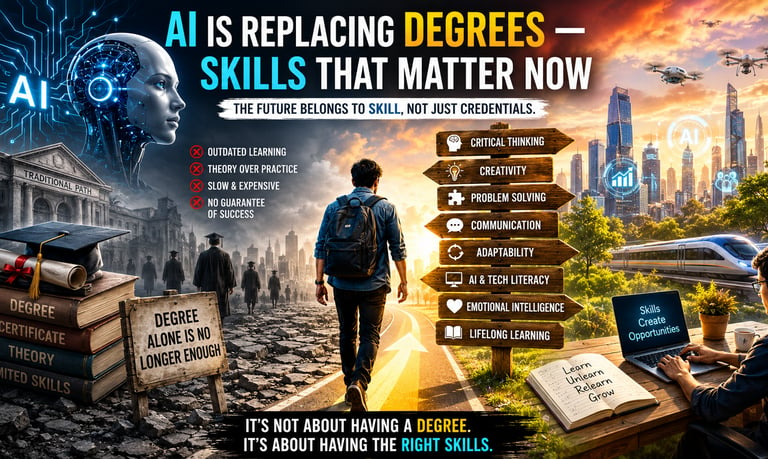
For generations, a college degree was considered the ultimate gateway to opportunity.
Parents encouraged it.
Schools prioritized it.
Employers demanded it.
A degree was more than an educational qualification. It was a signal of competence, discipline, and employability.
But a profound shift is now underway.
The rise of artificial intelligence is not simply transforming industries. It is forcing society to rethink one of its oldest assumptions:
Does a degree still guarantee professional relevance?
Increasingly, employers, technology leaders, and economic researchers are arriving at a similar conclusion:
In the age of AI, skills matter more than credentials.
This does not mean degrees are becoming worthless.
It means they are no longer sufficient.
The future belongs not to those who possess information, but to those who can apply, adapt, create, and solve problems in ways that machines cannot easily replicate.
The Traditional Degree Model Was Built for a Different Economy
Universities emerged during an era when information was scarce.
Students attended lectures because knowledge was concentrated within institutions.
Degrees served as proof that individuals had acquired valuable expertise unavailable elsewhere.
Today, information has become abundant.
A student can access:
world-class lectures,
research papers,
coding tutorials,
business courses,
professional certifications,
and AI-powered learning tools
from almost anywhere in the world.
Artificial intelligence has accelerated this transformation dramatically.
Tools powered by AI can now:
explain complex concepts,
write code,
summarize research,
generate presentations,
assist with design,
and provide personalized learning support.
Knowledge itself is becoming increasingly accessible.
The differentiator is no longer access to information.
The differentiator is what individuals can do with that information.
Employers Are Already Changing Hiring Practices
One of the strongest signals of this shift comes from the labor market itself.
Major employers across the United States have gradually reduced degree requirements for numerous roles.
Companies increasingly emphasize:
demonstrated skills,
practical experience,
certifications,
portfolios,
project work,
and problem-solving ability.
Research from the World Economic Forum highlights that employers increasingly prioritize skills such as analytical thinking, creativity, resilience, leadership, and technological literacy over traditional credentials alone.
The Future of Jobs Report identifies analytical thinking as the most important core skill for the coming decade, followed closely by creative thinking, adaptability, and lifelong learning.
The message is clear:
The market is moving toward capability-based hiring.
AI Is Automating Knowledge Work
Historically, automation primarily affected physical labor.
Artificial intelligence is changing that.
Today, AI is increasingly capable of performing tasks once associated with highly educated professionals.
Generative AI can:
draft reports,
write marketing content,
generate software code,
analyze data,
create visual designs,
and automate administrative tasks.
Research from McKinsey estimates that generative AI could automate substantial portions of knowledge work across industries ranging from finance and law to education and healthcare.
This does not mean professionals will disappear.
It means routine intellectual work is becoming automated.
As AI handles repetitive cognitive tasks, employers will increasingly value uniquely human capabilities.
The Most Valuable Skills in the AI Era
The rise of AI is elevating skills that machines struggle to replicate.
Critical Thinking
AI generates answers. Humans must determine whether those answers are correct.
The ability to:
evaluate information,
question assumptions,
identify bias,
and make sound judgments
is becoming increasingly valuable.
As misinformation and AI-generated content proliferate, critical thinking becomes a competitive advantage.
Creativity
Artificial intelligence can generate content.
Original creativity remains distinctly human.
Future opportunities will increasingly belong to individuals capable of:
generating novel ideas,
solving unfamiliar problems,
creating new products,
and imagining possibilities beyond existing patterns.
Creativity is no longer a luxury skill.
It is becoming an economic necessity.
Communication
Technical knowledge alone is insufficient.
Professionals who can:
explain complex ideas,
influence stakeholders,
build trust,
negotiate effectively,
and communicate across cultures
will continue to thrive.
Human connection remains difficult to automate.
Emotional Intelligence
AI can analyze emotions.
It cannot genuinely experience them.
Leadership, empathy, relationship-building, conflict resolution, and emotional awareness remain deeply human capabilities.
Research consistently shows emotional intelligence contributes significantly to workplace performance and leadership effectiveness.
As technology advances, human-centered skills become increasingly important.
Adaptability
Perhaps the most important skill of all is adaptability.
The future labor market will evolve continuously.
Professionals may need to reinvent themselves multiple times during their careers.
Those who can learn quickly, embrace change, and acquire new capabilities will remain competitive regardless of technological disruption.
The Rise of Skills-Based Education
The educational landscape is already adapting.
Alternative pathways are expanding rapidly:
professional certifications,
boot camps,
micro-credentials,
online learning platforms,
apprenticeships,
and project-based learning.
Employers increasingly evaluate what candidates can demonstrate rather than simply what credentials they possess.
A portfolio often speaks louder than a diploma.
A proven skill frequently matters more than a transcript.
This does not eliminate the value of higher education.
Rather, it shifts the focus from credentials alone to demonstrated competence.
Degrees Still Matter — But Differently
Despite the growing emphasis on skills, declaring the death of the college degree would be premature.
Universities continue providing significant benefits:
foundational knowledge,
research exposure,
professional networks,
mentorship,
critical thinking development,
and personal growth.
Certain professions such as medicine, law, engineering, and academia will continue requiring formal education.
However, the role of degrees is changing.
A degree is increasingly becoming the starting point rather than the destination.
Graduates can no longer assume that a diploma alone guarantees career success.
Continuous learning has become essential.
Lifelong Learning Is the New Competitive Advantage
Perhaps the most significant lesson of the AI era is that learning can no longer end after graduation.
Technology evolves too quickly. Industries transform too rapidly. Skills become outdated faster than ever before.
The professionals most likely to succeed are not necessarily those with the most prestigious degrees.
They are the individuals who remain curious.
They continuously:
learn,
adapt,
experiment,
and grow.
In a world shaped by AI, the ability to learn may become more valuable than any single qualification.
What Parents and Students Must Understand
For decades, educational success followed a predictable formula:
Study hard.
Earn a degree.
Secure a stable career.
That formula is becoming less reliable.
Parents, educators, and students must recognize that future success depends on far more than academic credentials.
Young people should be encouraged to develop:
communication skills,
critical thinking,
creativity,
emotional intelligence,
adaptability,
digital literacy,
and entrepreneurial thinking.
These capabilities will remain valuable even as technology transforms the workplace.
The Future Belongs to Those Who Can Do What AI Cannot
Artificial intelligence is extraordinary at processing information.
It is less effective at:
wisdom,
empathy,
leadership,
creativity,
ethical judgment,
and deep human understanding.
The future labor market will increasingly reward people who combine technical competence with distinctly human capabilities.
Degrees may open doors.
Skills will determine what happens after those doors open.
And as AI continues reshaping the global economy, one truth is becoming increasingly clear:
The most valuable credential of the future may not be a degree hanging on a wall.
It may be the ability to continuously learn, think, adapt, and create in a world where machines can do many things—but still cannot fully understand what it means to be human.