AI Tutors vs Human Teachers: The Future of Education Is Not What We Think
Will AI replace teachers? It's one of the most important questions facing education today. AI tutors can explain concepts instantly, personalize lessons, identify learning gaps, and provide support 24/7. In many ways, they are already transforming how students learn. But education has never been only about delivering information. A great teacher does far more than explain a chapter. They inspire confidence. They nurture curiosity. They recognize potential. They teach resilience, empathy, values, and character. As artificial intelligence becomes more powerful, the real debate is not AI versus teachers. The real question is whether we can combine the efficiency of AI with the wisdom and humanity of exceptional educators. The future of education may belong neither to machines nor to humans alone. It may belong to those who learn how to bring out the best in both. What do you think? Will AI eventually replace teachers, or will it become the most powerful teaching assistant ever created?
EDUCATION
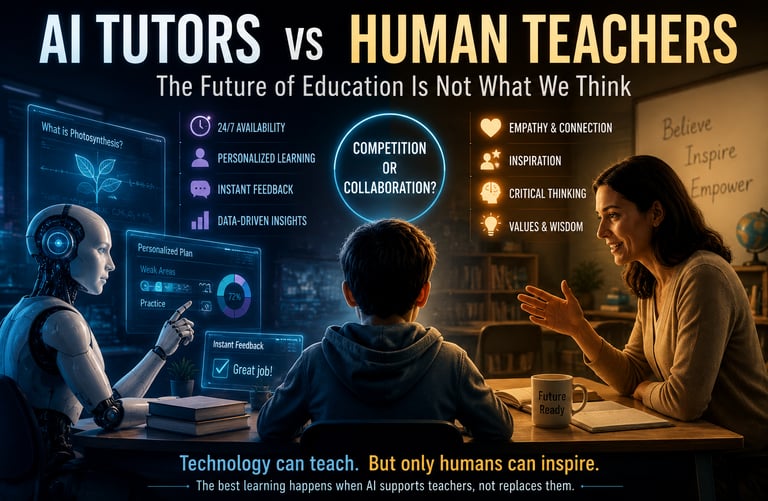
For centuries, education has been built around a simple but powerful relationship:
A teacher guiding a student.
From ancient philosophers mentoring disciples to modern classrooms shaping future generations, human teachers have been at the center of learning.
Today, however, a profound question is emerging across schools, universities, and educational institutions worldwide:
What happens when artificial intelligence becomes a better tutor than most humans?
The rise of AI-powered learning platforms is transforming education at an unprecedented pace. Students can now receive instant explanations, personalized feedback, customized lesson plans, language support, and 24/7 academic assistance from intelligent systems.
For the first time in history, access to knowledge is no longer limited by geography, classroom size, or teacher availability.
Yet amid this technological revolution, an equally important question remains:
Can AI truly replace a human teacher?
The answer may determine the future of education itself.
The Rise of the AI Tutor
The traditional classroom model was designed during the Industrial Age.
One teacher.
Many students.
Standardized instruction.
Uniform pacing.
Limited personalization.
While this model has educated billions, it has always faced one major limitation:
Every student learns differently.
Some learn quickly.
Others need repetition.
Some thrive through visuals.
Others prefer discussion.
Some require emotional encouragement before academic progress becomes possible.
Human teachers have long attempted to address these differences, often while managing dozens of students simultaneously.
Artificial intelligence changes this equation.
Modern AI systems can:
personalize lessons,
adapt learning speed,
provide instant feedback,
identify learning gaps,
generate practice questions,
explain concepts repeatedly,
and offer support at any time of day.
What once required hours of tutoring can now happen within minutes.
This is one reason educational technology experts increasingly view AI tutoring as one of the most disruptive developments in modern education.
Why Students Are Embracing AI
Many students already use AI as a learning companion.
Unlike traditional tutoring, AI offers:
Unlimited Patience
Students can ask the same question multiple times without fear of judgment.
Instant Availability
Help is available 24 hours a day.
Personalized Learning
Lessons can be adjusted to individual needs and learning styles.
Lower Cost
AI tutoring can significantly reduce the expense associated with private tutoring.
Continuous Feedback
Students receive immediate responses instead of waiting for assignments to be reviewed.
For many learners, particularly those who lack access to quality educational resources, AI represents an unprecedented opportunity.
Education is becoming more accessible than ever before.
The Limits of Artificial Intelligence
Despite its remarkable capabilities, AI has significant limitations.
The fundamental purpose of education extends far beyond information transfer.
Education is also about:
character,
confidence,
empathy,
ethics,
curiosity,
resilience,
and human development.
These dimensions remain deeply human.
A student struggling with self-doubt may need encouragement more than information.
A child facing emotional challenges may require understanding rather than instruction.
A classroom conflict may demand wisdom, empathy, and emotional intelligence.
AI can simulate support.
Human teachers genuinely experience it.
This distinction matters.
Knowledge can be automated.
Human connection cannot.
Great Teachers Do More Than Teach
When people reflect on the educators who changed their lives, they rarely remember them solely for academic content.
They remember:
inspiration,
encouragement,
mentorship,
belief,
and guidance.
A great teacher often sees potential before a student sees it themselves.
They challenge assumptions.
They nurture confidence.
They help shape identity.
These responsibilities extend far beyond delivering lessons.
Research consistently demonstrates that teacher-student relationships significantly influence:
motivation,
academic performance,
emotional well-being,
and long-term life outcomes.
Technology can support these relationships.
Replacing them entirely is another matter.
The Risk of Confusing Information with Education
One of the greatest misconceptions surrounding AI is the belief that information equals education.
Information is important.
But education requires transformation.
A student may know mathematical formulas without understanding how to solve real-world problems.
A learner may memorize facts without developing wisdom.
A person may consume enormous amounts of information while lacking critical thinking skills.
Education is not merely about acquiring answers.
It is about learning how to ask better questions.
Human teachers play a critical role in this process.
They help students:
think critically,
challenge assumptions,
explore uncertainty,
and develop intellectual independence.
These abilities become increasingly valuable in an AI-driven world.
The Skills That Will Matter Most
Ironically, the rise of AI is increasing the importance of uniquely human capabilities.
As machines become better at delivering information, education must increasingly focus on skills that machines struggle to replicate.
These include:
Critical Thinking
Evaluating information and making sound judgments.
Creativity
Generating original ideas and innovative solutions.
Communication
Expressing thoughts clearly and building understanding.
Emotional Intelligence
Understanding emotions, relationships, and human behavior.
Ethical Reasoning
Making responsible decisions in complex situations.
Collaboration
Working effectively with others.
These skills are best developed through human interaction, mentorship, discussion, and experience.
The Real Future: Human Teachers Enhanced by AI
The debate between AI tutors and human teachers often creates a false choice.
The future is unlikely to belong exclusively to either.
Instead, the most effective educational model may combine the strengths of both.
AI excels at:
personalization,
repetition,
data analysis,
administrative support,
and content delivery.
Human teachers excel at:
inspiration,
mentorship,
emotional support,
leadership,
and character development.
Together, they create a powerful partnership.
In this model:
AI handles routine instructional tasks.
Teachers focus on higher-value human interactions.
Rather than replacing educators, AI could free them to become even more impactful.
The Classroom of the Future
Imagine a classroom where:
Every student receives personalized AI-assisted learning.
Learning gaps are identified instantly.
Assignments adapt automatically to individual needs.
Teachers spend less time grading and more time mentoring.
Students receive both technological support and human guidance.
This future is increasingly possible.
The goal should not be to choose between humans and machines.
The goal should be to leverage technology while preserving what makes education deeply human.
What Schools and Parents Should Do Now
As AI becomes integrated into education, schools and families must act thoughtfully.
Teach Students How to Use AI Responsibly
Students should learn how to:
verify information,
think critically,
and avoid overdependence on technology.
Prioritize Human Skills
Schools should place greater emphasis on:
communication,
creativity,
emotional intelligence,
leadership,
and ethical reasoning.
Train Teachers in AI Integration
Educators should be empowered to use AI as a tool rather than fear it as a threat.
Preserve Human Connection
Technology should enhance learning, not replace meaningful relationships.
Encourage Independent Thinking
Students should use AI to support thinking, not substitute for it.
The Most Important Question
The future of education is not about whether AI tutors will become smarter.
They almost certainly will.
The more important question is:
Will we use technology to create better learners or merely more efficient consumers of information?
Education has always been about more than knowledge.
It is about helping human beings discover who they are and what they can become.
Artificial intelligence can accelerate learning.
But it cannot replace belief, empathy, mentorship, inspiration, and human connection.
The most successful schools of the future may therefore not be those that choose between AI and teachers.
They will be the ones that combine the efficiency of artificial intelligence with the wisdom of exceptional educators.
Because the future of education is not human versus machine.
It is human and machine working together to unlock human potential.