AI Will Replace Average Thinking; The Future Belongs to Deep Thinkers
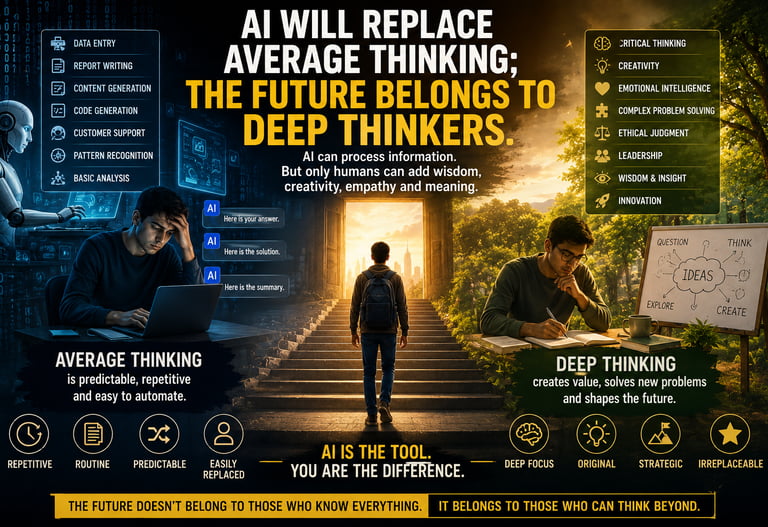
Artificial Intelligence is changing the world faster than most people imagined. Tasks that once required human effort, analysis, and repetition can now be completed within seconds. But as AI grows smarter, one truth is becoming increasingly clear: The future will not belong to those who simply consume information. It will belong to those who can think deeply, question intelligently, and create meaning beyond algorithms. Average thinking follows patterns. Deep thinking creates new possibilities. In a world filled with automation, the most valuable human skills may become: • critical thinking • creativity • emotional intelligence • ethical judgment • deep focus • innovation • wisdom AI can generate answers. But only humans can bring purpose, empathy, imagination, and vision. Perhaps the greatest skill of the future will not be knowing everything. It will be the ability to think beyond what machines can predict.
EDUCATION
For years, intelligence was associated with how much information a person could memorize, process, or reproduce.
But artificial intelligence is changing that equation rapidly.
Today, AI can:
write essays,
generate code,
summarize books,
create presentations,
solve mathematical problems,
produce marketing campaigns,
and answer complex questions within seconds.
Tasks that once required hours of human effort can now be completed almost instantly.
This has created both excitement and fear across industries, classrooms, and workplaces.
But beneath the noise surrounding artificial intelligence lies a deeper truth:
AI may not replace humanity.
It may replace average thinking.
And that changes everything.
The Era of Information Advantage Is Ending
For decades, success was built around access to information.
The people who knew more often had the advantage.
Today, information is abundant, searchable, and increasingly automated.
AI tools can retrieve knowledge faster than any human mind.
This means the future value of human intelligence may no longer depend primarily on:
memorization,
repetitive analysis,
or predictable problem-solving.
Instead, the future will reward qualities machines struggle to replicate:
original thinking,
judgment,
wisdom,
creativity,
ethical reasoning,
emotional intelligence,
and deep understanding.
The world is shifting from an information economy to a thinking economy.
The Rise of AI Is Already Reshaping Work
Recent global reports suggest that artificial intelligence is transforming workplaces faster than many institutions anticipated.
The World Economic Forum’s Future of Jobs Report highlights analytical thinking, resilience, creativity, leadership, and lifelong learning among the most critical skills for the coming years. (weforum.org)
Meanwhile, major technology firms and business leaders increasingly emphasize that AI will automate routine cognitive tasks while increasing demand for people capable of strategic thinking, innovation, and complex decision-making.
A 2026 report from McKinsey & Company notes that generative AI is accelerating workplace transformation across sectors such as education, finance, healthcare, media, and software development. (mckinsey.com)
The implication is clear:
The safer skills are no longer merely technical.
They are deeply human.
Average Thinking Is Becoming Automated
Average thinking follows patterns.
It repeats familiar frameworks.
It stays within predictable boundaries.
It often relies on existing answers.
That is precisely where AI performs exceptionally well.
Artificial intelligence thrives on:
pattern recognition,
prediction,
repetition,
data synthesis,
and scalable automation.
If human work becomes purely repetitive, standardized, or formula-driven, machines will increasingly perform it faster and cheaper.
This is not limited to factory work anymore.
It now includes:
writing,
customer support,
coding,
research,
design,
administration,
and even aspects of decision-making.
The challenge is no longer whether AI can assist human work.
The challenge is whether humans can continue creating value beyond what AI can automate.
Deep Thinkers Will Become Increasingly Valuable
Deep thinking is different from information consumption.
It requires:
reflection,
intellectual curiosity,
independent reasoning,
long-term perspective,
and the ability to connect ideas meaningfully.
Deep thinkers do not merely react to information.
They question it.
They synthesize across disciplines.
They tolerate complexity.
They identify patterns others miss.
They solve problems that do not yet have predefined answers.
In a world flooded with instant content and AI-generated outputs, genuine depth may become one of the rarest forms of intelligence.
And rare skills become valuable.
The Attention Economy Is Working Against Deep Thinking
Ironically, the modern digital environment makes deep thinking harder than ever.
Short-form content, constant notifications, endless scrolling, and algorithmic stimulation are conditioning minds toward rapid consumption rather than sustained reflection.
People are consuming more information than any generation in history while often spending less time thinking deeply about it.
This creates a dangerous illusion:
Being informed is not the same as being thoughtful.
Knowledge without reflection can easily become noise.
The future may therefore belong not to those who consume the most information, but to those who can process it meaningfully.
Education Systems Must Adapt Urgently
Many education systems still reward:
memorization,
standardized responses,
predictable answers,
and exam-oriented learning.
But AI is making many traditional educational advantages less relevant.
If a machine can instantly retrieve facts and generate summaries, then education must evolve beyond information transfer.
The real role of education in the AI age should be to develop:
critical thinking,
ethical judgment,
creativity,
emotional resilience,
communication,
and intellectual independence.
Children entering the future workforce will compete not only against other humans, but against increasingly capable machines.
Their greatest advantage may not be technical speed.
It may be depth of thought.
Human Skills Will Become Premium Skills
As AI capabilities grow, deeply human qualities may become economically and socially more valuable.
These include:
empathy,
leadership,
creativity,
storytelling,
intuition,
ethical reasoning,
emotional intelligence,
and philosophical thinking.
Technology may generate answers.
But humans still define meaning.
Machines may optimize efficiency.
But humans still shape purpose.
Frequently Asked Questions (FAQs)
Will AI replace all jobs?
No. AI is more likely to transform jobs than eliminate all work entirely. Roles involving repetitive and predictable tasks face higher automation risk, while human-centered, creative, strategic, and emotionally intelligent roles may grow in importance.
What skills will matter most in the AI era?
Reports consistently highlight:
analytical thinking,
creativity,
adaptability,
communication,
leadership,
emotional intelligence,
and lifelong learning as critical future skills.
Why is deep thinking becoming more valuable?
Because AI can increasingly handle routine cognitive work. Humans who can think independently, solve unfamiliar problems, and generate original insights will become more difficult to replace.
How can parents prepare children for the AI age?
Children should be encouraged to:
read deeply,
ask questions,
develop curiosity,
build emotional resilience,
learn communication skills,
and spend time thinking creatively beyond screens and standardized testing.
Is AI dangerous for human thinking?
AI itself is a tool. The larger concern is passive dependence. If people stop questioning, reflecting, and thinking independently, critical reasoning skills may weaken over time.
The Real Question Humanity Must Ask
The future may not divide people simply by intelligence.
It may divide them by depth.
Those who rely entirely on automated thinking may gradually lose the ability to think independently.
Those who continue cultivating curiosity, reflection, emotional wisdom, and intellectual depth may become the true leaders of the AI era.
Artificial intelligence will continue advancing rapidly.
But the future may still belong to something profoundly human:
The ability to think deeply in a world addicted to speed.