In the Age of AI, Human Judgment Is Becoming More Valuable Than Knowledge
For centuries, knowledge was power. Today, knowledge is available to anyone with an internet connection and an AI assistant. The real competitive advantage is shifting. As artificial intelligence becomes better at finding answers, generating content, analyzing data, and solving routine problems, a new question emerges: What remains uniquely human? The answer is judgment. The ability to evaluate information, understand context, make ethical decisions, navigate uncertainty, and choose the right course of action is becoming more valuable than ever before. AI can provide possibilities. Humans must decide priorities. AI can process information. Humans must determine meaning. In a world overflowing with knowledge, wisdom may become the rarest skill of all. The future will not belong to those who know the most. It will belong to those who can think critically, judge wisely, and act thoughtfully. Do you believe human judgment will become the most valuable skill in the AI era?
EDUCATION
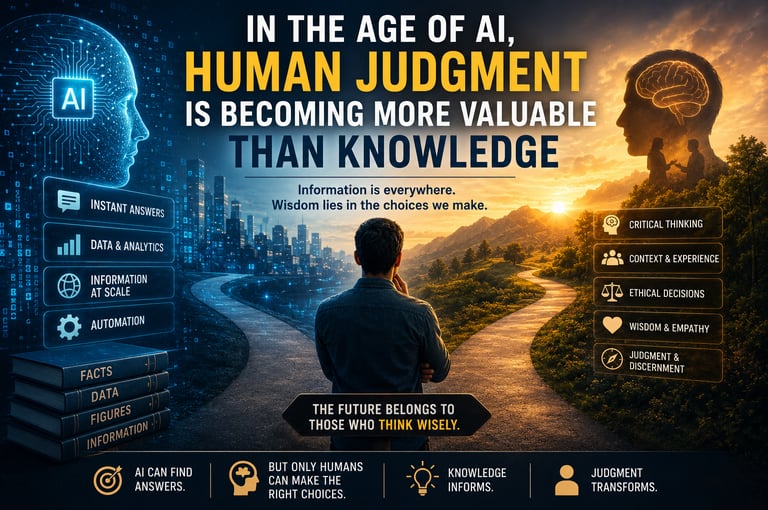
For centuries, knowledge was the ultimate source of power. Those who possessed information held a distinct advantage over those who did not. Educational institutions were built around the acquisition of knowledge, careers were defined by expertise, and professional success often depended on how much a person knew compared to others.
Today, however, we are witnessing one of the most significant shifts in human history.
Artificial intelligence can now answer questions, summarize books, analyze data, write reports, generate code, and explain complex concepts within seconds. Information that once took hours or even days to find is now available almost instantly.
As AI democratizes access to knowledge, a new reality is emerging: knowledge is becoming abundant, while human judgment is becoming increasingly scarce. In a world overflowing with information, the ability to make sound decisions may soon become the most valuable skill of all.
The End of Knowledge as a Competitive Advantage
For generations, access to information was limited. Students relied on libraries, professionals depended on specialized training, and organizations invested heavily in knowledge management because information was difficult to acquire.
Artificial intelligence has fundamentally changed this equation.
Today, anyone with an internet connection can use AI-powered tools to research topics, learn new skills, generate ideas, analyze trends, and solve complex problems. Knowledge is no longer locked inside institutions. It is available to nearly everyone.
This is one of the greatest achievements of the digital age. However, it also changes the nature of competition. When everyone has access to the same information, information alone ceases to be a meaningful differentiator.
The question is no longer who knows the most.
The question is who can think the best.
Knowledge Provides Information. Judgment Creates Value.
Artificial intelligence is remarkably effective at generating answers. However, answers are not the same as decisions.
A business leader may receive multiple strategic recommendations from an AI system. An investor may gain access to thousands of financial insights. A student may obtain instant explanations for complex concepts. A doctor may receive diagnostic suggestions generated by advanced algorithms.
Yet in every case, a human being must still decide what information to trust, what risks to consider, what priorities matter, and what actions should be taken.
This is where judgment becomes indispensable.
Knowledge tells us what is possible. Judgment determines what is wise.
The Problem With Unlimited Information
One of the defining challenges of modern society is not information scarcity but information overload.
Every day, people are exposed to a relentless stream of content, including news updates, social media posts, AI-generated articles, expert opinions, research studies, videos, and recommendations. The sheer volume of information available today exceeds anything previous generations experienced.
Ironically, more information does not necessarily lead to better decisions.
In many cases, it creates confusion, distraction, and uncertainty.
The modern challenge is no longer finding information. The challenge is identifying what deserves attention and determining which insights are actually useful.
This requires judgment, not simply knowledge.
Why Critical Thinking Is Becoming Essential
As artificial intelligence becomes more powerful, critical thinking is emerging as one of the most valuable skills in the modern workforce.
Organizations increasingly need people who can evaluate information rather than simply consume it. The ability to ask thoughtful questions, identify assumptions, recognize bias, and assess evidence has become a significant competitive advantage.
Critical thinkers do not automatically accept every answer they receive. They examine the quality of information, explore alternative perspectives, and understand that even the most sophisticated AI systems can produce inaccurate or misleading outputs.
In an age where information is abundant, independent thinking becomes a rare and valuable capability.
AI Understands Patterns. Humans Understand Context.
Artificial intelligence excels at recognizing patterns within large datasets. It can identify trends, predict outcomes, and generate recommendations based on enormous amounts of information.
However, context remains one of the greatest challenges for machines.
Human decisions are rarely based on data alone. They involve emotions, values, ethics, relationships, culture, timing, and experience.
Consider a business decision. Data may indicate that a particular strategy is financially optimal. Yet factors such as employee morale, customer trust, organizational culture, and long-term reputation may point toward a different conclusion.
Similarly, an AI system might identify a student's academic weakness, while a teacher recognizes that the real challenge is confidence, motivation, or emotional well-being.
Data provides insight.
Judgment provides understanding.
The difference matters.
The Future Workplace Will Reward Decision-Makers
For decades, many professional roles focused on gathering information, creating reports, conducting research, and managing routine knowledge work.
Artificial intelligence is increasingly capable of performing these tasks.
As a result, employers are beginning to place greater value on capabilities that machines struggle to replicate. Strategic thinking, decision-making, leadership, creativity, communication, and ethical reasoning are becoming more important than ever before.
The professionals who thrive in the coming decades will not necessarily be those who possess the most information. They will be those who can interpret information effectively and make thoughtful decisions under uncertainty.
The future workplace will reward judgment over memorization.
Why Education Must Evolve
The rise of AI presents a profound challenge for educational systems around the world.
Traditional education has often emphasized memorization and information recall. Students are rewarded for remembering facts, formulas, and definitions.
However, when AI can retrieve information instantly, the value of memorization begins to diminish.
This does not mean knowledge is unimportant. Foundational knowledge remains essential. But education must increasingly focus on helping students develop higher-order thinking skills.
Schools and universities should prioritize:
Critical thinking
Problem-solving
Communication
Creativity
Ethical reasoning
Collaboration
Decision-making
The future belongs not to those who can remember the most information, but to those who can use information wisely.
Wisdom Is the New Competitive Advantage
There is an important distinction between knowledge and wisdom.
Knowledge involves understanding facts.
Wisdom involves applying those facts appropriately.
A person may understand financial markets but make poor financial decisions. A leader may possess extensive expertise but lack the judgment required to guide people effectively. An AI system may generate hundreds of recommendations but remain unable to fully understand human values and consequences.
Wisdom emerges through experience, reflection, empathy, humility, and thoughtful consideration. These qualities cannot be automated. They must be cultivated.
As AI becomes increasingly capable, wisdom may become one of humanity's most valuable assets.
How Individuals Can Strengthen Their Judgment
The encouraging reality is that judgment can be developed. Individuals can strengthen their decision-making abilities by reading broadly, exploring multiple perspectives, engaging in deep reflection, and learning from both successes and failures.
It is equally important to resist the temptation to outsource thinking entirely to technology. AI should be used as a tool that enhances human intelligence rather than replaces it.
Some practical ways to strengthen judgment include:
Reading beyond headlines and summaries.
Seeking diverse viewpoints.
Practicing deep work and focused thinking.
Reflecting on personal decisions and outcomes.
Asking better questions before accepting answers.
Using AI to support analysis rather than substitute for reasoning.
The goal is not to compete with artificial intelligence. The goal is to become more human.
The Future Belongs to Thoughtful Humans
Artificial intelligence will continue to transform every aspect of society. Knowledge will become even more accessible, information will become even more abundant, and automation will continue reshaping industries.
Yet abundance often increases the value of scarcity.
As information becomes abundant, judgment becomes precious.
As answers become automated, wisdom becomes strategic.
As artificial intelligence becomes smarter, human thinking becomes more important.
The individuals and organizations that thrive in the AI era will not simply be those with access to the most information. They will be those capable of applying information with clarity, wisdom, and sound judgment.
Because in a world where machines can provide answers in seconds, the ultimate competitive advantage may be the uniquely human ability to decide which answers truly matter.