Parents Are Preparing Kids for Exams, Not Life
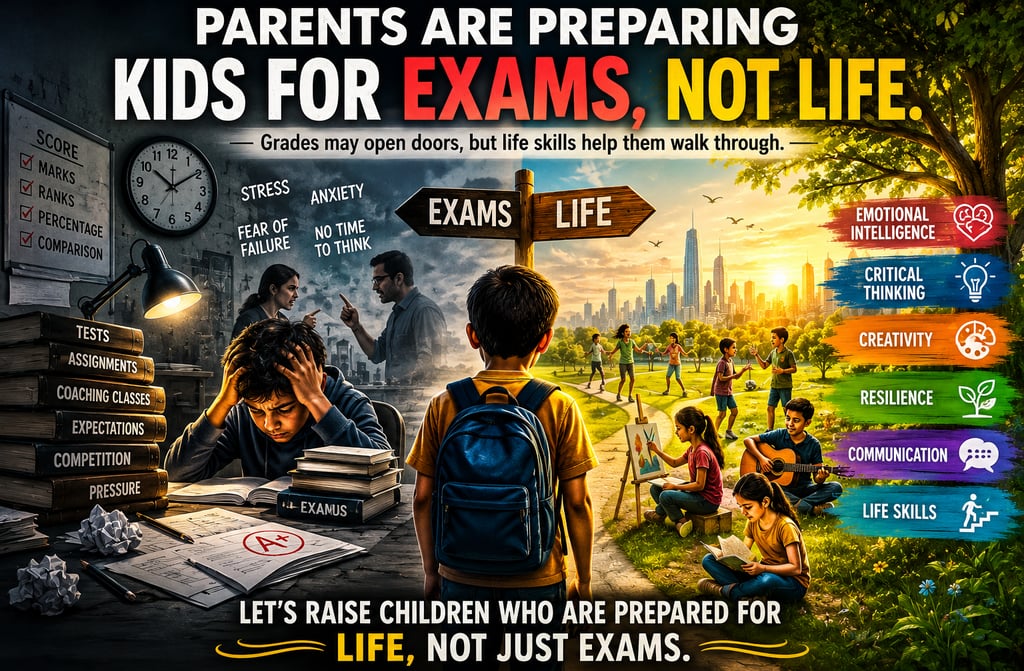
Are we raising children to succeed in exams or to succeed in life? Across the world, children are growing up under immense pressure to score higher, compete harder, and constantly prove themselves academically. But while marks may open doors, life demands far more than report cards. The future will belong to those who can: • think critically • adapt to change • communicate effectively • manage emotions • solve real problems • remain resilient during uncertainty Yet many children are spending their most important years trapped in a cycle of tests, rankings, comparison, and fear of failure. Education must go beyond memorization. Our children do not just need academic excellence. They need emotional strength, creativity, confidence, empathy, and purpose. Perhaps it is time to ask ourselves a deeper question: Are we preparing children only for examinations, or are we preparing them for life itself?
EDUCATION
In homes across the world, a familiar conversation repeats itself every day:
“Did you finish your homework?”
“How many marks did you score?”
“Are you prepared for the test?”
Rarely do we ask:
“Are you emotionally strong?”
“Do you know how to handle failure?”
“Can you think independently?”
“Are you genuinely happy?”
Somewhere along the journey of modern parenting and education, success became narrowly defined by academic performance. Marks became identity. Exams became destiny. Childhood became preparation for competition.
But an uncomfortable question is now emerging globally:
What happens when children become academically prepared but emotionally unprepared for life?
The Pressure to Perform Has Reached Unprecedented Levels
Recent global reports suggest that academic pressure and performance anxiety among children and adolescents are becoming serious mental health concerns.
A joint initiative by the World Health Organization and UNICEF highlights the urgent global need to strengthen mental health and psychosocial support systems for children and adolescents. (World Health Organization)
According to a global survey conducted by UNICEF and Gallup across 21 countries, nearly 59% of young people believe children today face greater pressure to succeed than previous generations. (changingchildhood.unicef.org)
This pressure is no longer limited to academics alone. It now extends to:
social comparison,
career uncertainty,
digital expectations,
parental ambitions,
and fear of falling behind in an increasingly competitive world.
Children today are not merely studying harder. Many are growing up under constant psychological pressure.
Schools Are Producing High Performers, But Are We Producing Healthy Human Beings?
Modern education systems excel at measuring academic outcomes.
They measure:
grades,
rankings,
attendance,
and test performance.
But life does not operate like an examination hall.
Life tests:
resilience,
adaptability,
empathy,
emotional control,
communication,
ethical judgment,
and the ability to recover after failure.
Ironically, many of these life-defining skills receive little structured attention during a child’s formative years.
A child may solve complex mathematical equations yet struggle to manage anxiety, loneliness, rejection, or uncertainty.
That contradiction is becoming increasingly visible across societies.
The Silent Rise of Student Anxiety
Mental health experts and educators are raising alarms about rising anxiety levels among students.
Research and educational reports increasingly connect excessive academic pressure with:
anxiety disorders,
sleep problems,
emotional exhaustion,
reduced self-esteem,
and depression among adolescents. (The Times of India)
The World Health Organization notes that mental health conditions are now among the leading causes of illness and disability among young people globally. (World Health Organization)
At the same time, the digital age has intensified comparison culture.
Children are no longer compared only within classrooms. They are now competing against curated online realities visible every second through social media.
The result is a generation that often feels pressured to constantly prove its worth.
Parents Are Not Wrong. They Are Afraid.
Most parents pushing children toward academic achievement are not acting out of cruelty.
They are acting out of fear.
Fear of instability.
Fear of economic uncertainty.
Fear of limited opportunities.
Fear that their child may struggle in an unpredictable future.
And those fears are understandable.
The world is changing rapidly due to:
artificial intelligence,
automation,
shifting job markets,
and increasing competition.
However, in trying to secure children’s futures, many families unintentionally sacrifice something equally important: emotional well-being and holistic growth.
Children begin to internalize a dangerous belief:
“My worth depends on my performance.”
That belief may create achievers. But it can also create emotionally fragile adults.
The Future Will Reward More Than Academic Excellence
The future economy will not merely reward memorization or standardization.
Artificial intelligence is already transforming how information is accessed, processed, and applied.
What will increasingly matter are deeply human capabilities:
creativity,
critical thinking,
emotional intelligence,
collaboration,
ethical reasoning,
and lifelong learning.
Ironically, these are the very skills least emphasized in many exam-driven systems.
The future belongs not only to those who score highly, but to those who can adapt intelligently, think independently, and remain emotionally grounded during uncertainty.
Childhood Should Not Become a Constant Performance Review
Children need ambition.
But they also need balance.
They need discipline, but also emotional safety.
They need opportunities to excel, but also permission to fail without feeling broken.
A healthy childhood should include:
curiosity,
play,
reflection,
meaningful conversations,
creativity,
and the freedom to discover one’s identity beyond marksheets.
Education should not merely prepare children to earn a living.
It should prepare them to live meaningfully.
A New Definition of Success
Perhaps it is time to redefine what successful parenting truly means.
Success is not only raising children who:
top examinations,
secure prestigious careers,
or meet social expectations.
Real success may mean raising children who:
can face adversity without collapsing,
use technology wisely,
think with clarity,
treat others with compassion,
and remain mentally strong in a fast-changing world.
Because life after school will not ask children only what they scored.
It will ask:
how they handle pressure,
how they respond to failure,
how they build relationships,
and whether they truly understand themselves.
The Question We Must All Reflect Upon
Are we preparing children only to pass examinations?
Or are we preparing them to navigate life with wisdom, resilience, and humanity?
The difference between the two may define the future of an entire generation.