The Attention Crisis Is Destroying Young Minds
We are raising the most digitally connected generation in history, yet many young minds are struggling to focus, think deeply, and remain emotionally balanced. The real crisis today is not just screen time. It is the silent erosion of attention. Children are growing up in a world designed to constantly interrupt them through notifications, short videos, endless scrolling, and algorithm-driven stimulation. As attention spans shrink, anxiety rises, patience weakens, and deep thinking becomes rare. In the age of artificial intelligence, the ability to focus may become one of the greatest human advantages. Because while technology can deliver information instantly, wisdom still requires attention, reflection, and presence. Perhaps the question is no longer whether children should use technology. The real question is: How do we help them use technology without losing their ability to think, feel, imagine, and connect deeply? Attention is becoming the new superpower.ption.
EDUCATION
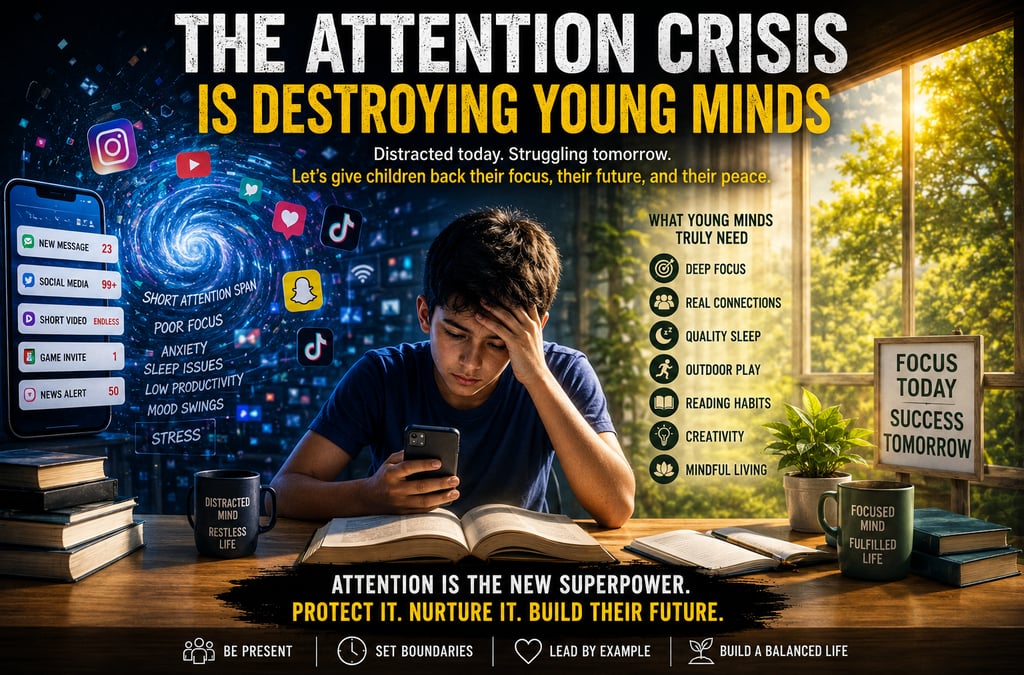
A child sits down to study.
Within minutes, a notification appears.
A message arrives.
A short video plays.
Another tab opens.
Attention shifts again.
What once interrupted concentration occasionally has now become the environment children grow up in every single day.
We are witnessing the rise of something far more serious than distraction.
We are witnessing an attention crisis.
And it may quietly become one of the defining psychological and educational challenges of this generation.
Attention Has Become the Most Valuable Resource of the Digital Age
The modern digital economy is not merely competing for money anymore.
It is competing for human attention.
Every platform, application, notification, algorithm, and short-form video is designed to capture, stimulate, and retain focus for as long as possible.
Children today are growing up inside systems engineered to interrupt them.
As a result, deep thinking is becoming harder.
Patience is shrinking.
Silence feels uncomfortable.
And sustained concentration is slowly disappearing.
The human mind was not designed for constant stimulation at industrial scale.
Yet for many children, uninterrupted attention has become increasingly rare.
The Research Is Becoming Difficult to Ignore
Recent reports across the world are raising serious concerns about the impact of excessive and problematic digital consumption on young minds.
A 2026 OECD report on youth mental health states that mental health among children and adolescents has been deteriorating across many countries for more than a decade, with anxiety, depression, and psychological distress rising consistently among younger populations.
In May 2026, the U.S. Department of Health and Human Services issued a public health advisory warning that excessive screen exposure among children and teenagers has become a growing concern due to its links with:
sleep disruption,
poor academic functioning,
reduced physical activity,
and weakened interpersonal relationships.
Another 2026 study published in the American Journal of Preventive Medicine tracked more than 8,000 adolescents and found that problematic use of phones, social media, and gaming platforms was associated with:
depressive symptoms,
attention difficulties,
sleep disturbances,
behavioral problems,
and suicidal behaviors one year later.
The issue is no longer simply “screen time.”
Researchers are increasingly focusing on addictive digital behavior patterns and their long-term cognitive and emotional consequences.
Children Are Losing the Ability to Be Bored
One of the greatest casualties of the digital era is boredom.
And boredom once played an essential role in human development.
Boredom encouraged:
imagination,
reflection,
curiosity,
creativity,
and independent thinking.
Today, the moment silence appears, stimulation replaces it instantly.
Children no longer wait.
They scroll.
They swipe.
They consume.
The brain becomes conditioned to expect continuous novelty.
As a result, activities requiring patience and deep engagement: reading, learning, reflecting, problem-solving, begin to feel emotionally demanding.
This is not laziness.
It is neurological conditioning.
The Crisis Is Not Only Technological. It Is Emotional.
The conversation around attention spans often becomes oversimplified.
Not every form of screen use is harmful.
Some recent research suggests that the quality and purpose of online engagement matter more than screen time alone. A large UK study tracking teenagers found no direct evidence that social media usage alone automatically causes mental health disorders.
That distinction matters.
The real danger may not simply be technology itself, but:
addictive platform design,
endless dopamine stimulation,
fragmented attention,
emotional comparison,
and the replacement of meaningful human experiences with digital substitutes.
Many children today are constantly connected yet internally restless.
They struggle to remain present because the mind has adapted to perpetual interruption.
Focus Is Becoming a Superpower
In an age of distraction, the ability to focus deeply may become one of the most valuable human skills.
The future will increasingly reward people who can:
think independently,
sustain concentration,
resist distraction,
learn deeply,
and create meaningful work.
Artificial intelligence can generate information instantly.
But wisdom still requires attention.
Creativity still requires stillness.
Emotional maturity still requires reflection.
And none of these grow in a permanently distracted mind.
Parents and Schools Are Facing a New Challenge
This generation of parents is raising children in a reality no previous generation experienced.
Digital devices are now:
classrooms,
entertainment centers,
social environments,
and emotional escape mechanisms simultaneously.
Completely eliminating technology is neither realistic nor practical.
But unlimited and unregulated exposure carries consequences.
The challenge is no longer whether children should use technology.
The real question is:
How do we help children use technology without losing their ability to think, feel, focus, and connect deeply?
That may become one of the most important parenting questions of this decade.
What Children Need Most Today
Children do not only need digital skills.
They need cognitive and emotional balance.
They need:
uninterrupted conversations,
outdoor play,
reading habits,
silence,
creativity,
human interaction,
deep learning,
and time away from algorithmic stimulation.
Most importantly, they need adults who model presence.
Because children learn attention not only through rules, but through observation.
The Future May Depend on This
The attention crisis is not merely about productivity.
It is about identity, emotional stability, learning capacity, and human connection.
A distracted generation may struggle not only to focus, but to understand itself.
And if society continues sacrificing deep attention for endless stimulation, we may produce children who are constantly entertained but internally exhausted.
The future will not belong only to the most intelligent people.
It may belong to those who can still pay attention.