The Hidden Emotional Cost of Modern Success
Success today looks glamorous from the outside. Promotions. Productivity. Hustle. Recognition. Financial growth. But behind the highlights, many people are quietly battling burnout, anxiety, emotional exhaustion, and the pressure to constantly keep up. Modern success has created a culture where people are expected to always be available, always improving, and always performing. The problem is not ambition. The problem is sacrificing mental peace, relationships, health, and identity in the pursuit of external achievement alone. Perhaps true success is not just about how much we earn. Perhaps it is also about: • protecting our emotional well-being • creating meaningful relationships • maintaining inner peace • finding balance in a hyperconnected world Because success should elevate life, not emotionally drain it.
EDUCATION
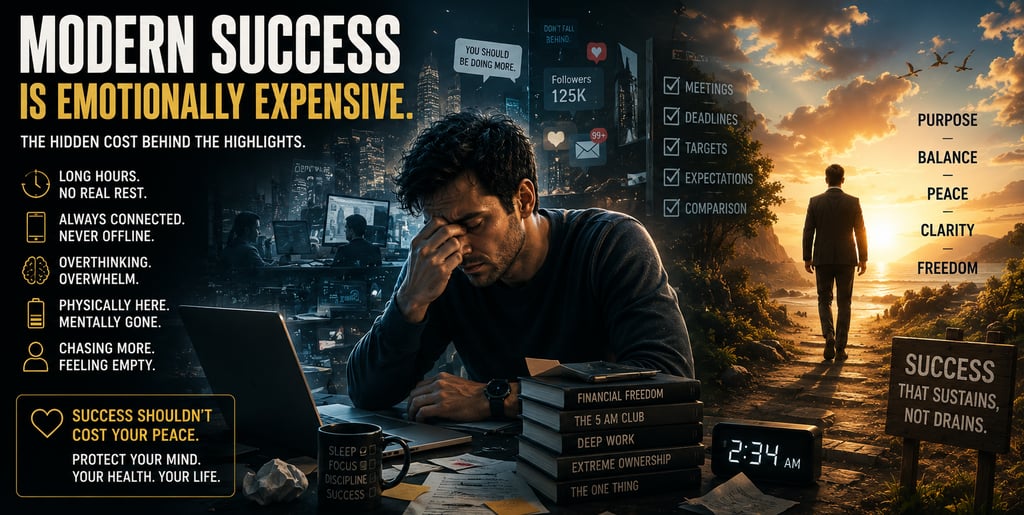

From the outside, modern success has never looked more attractive.
People today have access to:
global opportunities,
remote careers,
digital businesses,
personal brands,
financial freedom strategies,
and technologies previous generations could never imagine.
Social media constantly showcases achievement:
promotions, luxury lifestyles, startup exits, productivity routines, and carefully curated moments of “winning.”
Yet beneath this culture of visible success, something far less visible is quietly growing: Emotional Exhaustion.
Across the United States and much of the world, people are becoming professionally ambitious while simultaneously feeling mentally overwhelmed, emotionally disconnected, and chronically tired.
Modern success is no longer merely financially demanding; It is emotionally expensive.
The Success Economy Never Truly Stops
Previous generations often experienced clearer boundaries between work and personal life.
Today, those boundaries are disappearing.
Phones, laptops, notifications, and digital platforms have created a culture where many professionals feel psychologically connected to work almost all the time.
Even rest has become performative.
People now optimize:
sleep,
productivity,
routines,
fitness,
networking,
and even relaxation itself.
The pressure is no longer simply to succeed.
The pressure is to constantly improve.
This creates what many psychologists and workplace researchers now describe as “high-functioning burnout” — a condition where individuals continue performing outwardly while internally experiencing exhaustion, anxiety, emotional numbness, and declining well-being.
Burnout Is Becoming a Defining Feature of Modern Work Culture
The conversation around burnout has intensified significantly across the United States in recent years.
According to a 2026 report from the American Psychological Association, chronic workplace stress, economic uncertainty, and digital overload are contributing to rising emotional fatigue among working adults, especially younger professionals. (apa.org)
At the same time, workplace studies continue showing increasing levels of:
emotional exhaustion,
disengagement,
anxiety,
and work-related stress across industries.
A recent Gallup workplace survey found that many employees report feeling emotionally detached despite remaining professionally productive. (gallup.com)
This is one of the defining contradictions of modern achievement:
People are accomplishing more while often feeling less emotionally fulfilled.
Social Media Changed the Psychology of Success
Success used to be personal.
Now it is public.
Social media transformed achievement into continuous comparison.
Every scroll exposes people to:
promotions,
investment wins,
luxury vacations,
fitness transformations,
entrepreneurship success stories,
and carefully edited lifestyles.
The result is a psychological environment where many people feel permanently behind.
Even successful individuals increasingly experience:
comparison anxiety,
imposter syndrome,
fear of irrelevance,
and pressure to maintain visibility.
The emotional burden is intensified because modern success is no longer only about achievement itself.
It is also about perceived achievement.
And perception never truly rests.
High Achievement Often Comes With Hidden Emotional Costs
Society often celebrates outcomes while ignoring emotional consequences.
People admire:
the entrepreneur,
the executive,
the creator,
the high performer,
the investor,
the influencer.
But they rarely see:
the anxiety behind constant pressure,
the loneliness of ambition,
the fear of failure,
the exhaustion of maintaining success,
or the emotional instability caused by nonstop performance expectations.
Many professionals quietly struggle with a dangerous belief:
“My value depends on my productivity.”
Over time, identity becomes attached to achievement.
When that happens, rest begins to feel uncomfortable and self-worth becomes conditional.
Younger Generations Are Beginning to Question the Cost
Millennials and Gen Z are increasingly reevaluating traditional definitions of success.
Across American workplace culture, younger professionals are openly discussing:
burnout,
mental health,
emotional well-being,
work-life balance,
and psychological sustainability.
The rise of terms like:
“quiet quitting,”
“bare minimum Mondays,”
“soft life,”
and “work-life integration”
reflects a growing cultural shift.
Many younger workers are no longer asking only:
“How do I become successful?”
They are asking:
“What is success costing me emotionally?”
This is a fundamentally different conversation than previous generations often had.
Financial Success Does Not Automatically Create Emotional Security
One of the most misunderstood aspects of modern achievement is the assumption that financial success automatically produces peace of mind.
In reality, higher income often introduces:
higher expectations,
lifestyle inflation,
social pressure,
fear of losing status,
and constant performance anxiety.
The emotional system adapts quickly to external success.
What once felt extraordinary eventually becomes normal.
This psychological phenomenon, often called “hedonic adaptation,” explains why many high achievers continue chasing more without experiencing lasting satisfaction.
Success can improve quality of life.
But it cannot fully replace:
emotional stability,
meaningful relationships,
inner clarity,
purpose,
and psychological well-being.
Technology Accelerated the Pace of Human Life
Modern technology has dramatically increased efficiency.
But it has also accelerated psychological pressure.
People now consume:
more information,
more opinions,
more comparisons,
more opportunities,
and more expectations
than any generation before them.
The brain rarely gets true silence.
As a result, many individuals remain mentally stimulated even when physically resting.
The nervous system never fully disengages.
And over time, constant stimulation creates emotional fatigue that success alone cannot solve.
The Future May Require a New Definition of Success
For decades, success was largely measured through:
money,
titles,
productivity,
possessions,
and external achievement.
But modern society is increasingly discovering that external accomplishment without internal balance creates emotional instability.
Perhaps future success will be measured differently.
Not merely by:
how much someone earns,
how productive they appear,
or how impressive their lifestyle looks online.
But also by:
emotional resilience,
mental peace,
meaningful relationships,
depth of focus,
physical well-being,
and the ability to remain psychologically healthy in a hyperconnected world.
Ambition Is Not the Problem
Ambition itself is not dangerous.
Human progress depends on ambition, creativity, and achievement.
The real danger emerges when people sacrifice:
health,
identity,
relationships,
peace of mind,
and emotional stability
in pursuit of external validation alone.
A meaningful life requires both achievement and emotional sustainability.
Without balance, success can become psychologically expensive.
The Most Important Question of Modern Achievement
Perhaps the most important question professionals should ask today is not simply:
“How do I become successful?”
But rather:
“Can I build success without losing myself in the process?”
Because in a world obsessed with external performance, protecting inner well-being may become one of the greatest forms of intelligence.
Modern success can create opportunity, freedom, and influence.
But if success destroys emotional peace along the way, the victory becomes far more complicated than it appears from the outside.