The Lost Art of Deep Thinking in Kids: A Wakeup Call For All
Children today have access to more information than any generation in history. But they are slowly losing something far more important: the ability to think deeply. In a world filled with endless scrolling, short videos, instant answers, and constant digital stimulation, deep thinking is becoming rare among young minds. Yet creativity, curiosity, emotional intelligence, problem-solving, and innovation all grow from moments of reflection, focus, and imagination. The future will not belong only to children who consume information quickly. It will belong to those who can think independently, question deeply, and stay focused in a distracted world. Perhaps one of the greatest responsibilities of parents and educators today is not simply preparing children for exams, but protecting their ability to think deeply within a hyperconnected world.
EDUCATION
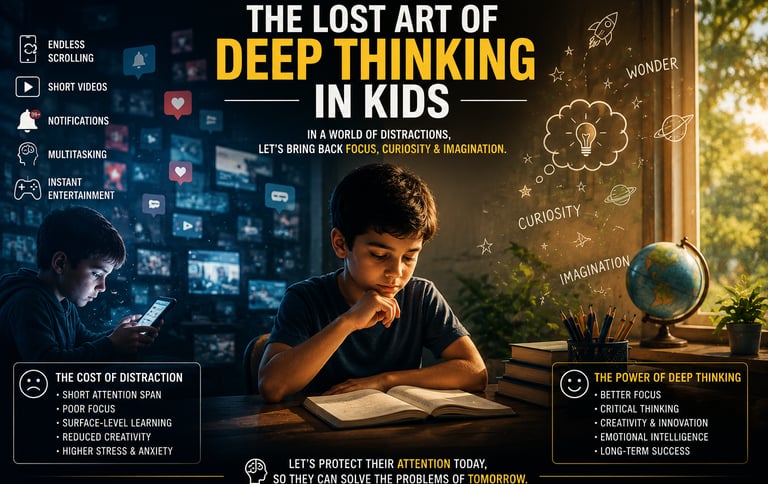
A child once sat under a tree and wondered why the sky changed colors at sunset.
Another spent hours building imaginary worlds from cardboard boxes.
Some children would stare at clouds, ask endless questions, read slowly, daydream freely, and lose themselves in curiosity.
Today, many children still have access to more information than any generation in history.
But something important is quietly disappearing: THE ABILITY TO THINK DEEPLY
In homes, classrooms, and digital spaces across the world, children are increasingly growing up in environments designed for speed, stimulation, and constant interruption. As attention spans shrink and distractions multiply, deep thinking is slowly becoming a lost art.
And the consequences may shape an entire generation.
Children Are Growing Up in a World of Constant Stimulation
Modern childhood looks dramatically different from previous generations.
Today’s children are surrounded by:
smartphones,
short-form videos,
instant entertainment,
rapid notifications,
multitasking,
and algorithm-driven content designed to capture attention continuously.
The average child no longer experiences boredom the way earlier generations once did.
The moment silence appears, stimulation replaces it instantly.
A video starts.
A notification arrives.
A screen lights up.
Attention shifts again.
This constant flow of stimulation trains the brain to expect speed rather than depth.
As a result, activities requiring sustained concentration such as:
reading,
reflection,
creative exploration,
problem-solving,
and independent thinking
can begin to feel emotionally difficult.
Deep Thinking Requires Time, Silence, and Patience
Deep thinking is not simply intelligence.
It is the ability to:
reflect carefully,
connect ideas,
question assumptions,
tolerate complexity,
and remain mentally engaged without constant stimulation.
These abilities develop slowly.
They require:
uninterrupted attention,
emotional calmness,
curiosity,
and moments of stillness.
But modern digital culture rarely rewards slowness.
Instead, children are increasingly conditioned toward:
rapid consumption,
instant answers,
fast entertainment,
and shortened attention cycles.
The danger is not merely distraction.
The danger is losing the mental habits required for deep thought itself.
Research Is Raising Serious Concerns
Educational researchers and psychologists are increasingly warning about the long-term effects of excessive digital stimulation on children’s cognitive development.
Recent OECD findings on child well-being and youth mental health indicate growing concerns around attention difficulties, emotional regulation, and declining focus among younger populations exposed to highly digital environments. (oecd.org)
At the same time, discussions across American education circles increasingly emphasize the importance of:
critical thinking,
creativity,
cognitive resilience,
and deep learning
as essential future skills in the age of artificial intelligence.
Ironically, these are the very abilities that constant distraction weakens.
Children Are Consuming More Information but Reflecting Less
One of the defining contradictions of modern childhood is this:
Children are exposed to enormous amounts of information, yet often spend less time deeply processing it.
Knowledge today is immediate.
Answers appear within seconds.
But wisdom develops differently.
Wisdom requires:
reflection,
questioning,
emotional understanding,
and intellectual patience.
Without these processes, information can become shallow consumption rather than meaningful learning.
A child who constantly scrolls may absorb content endlessly while rarely developing the ability to think independently about it.
Boredom Once Played an Important Role in Childhood
Modern culture often treats boredom as a problem to eliminate.
But boredom once served an important psychological function.
Boredom encouraged children to:
imagine,
invent,
explore,
reflect,
and create.
It pushed the mind inward.
Many of humanity’s greatest ideas emerged not from constant stimulation, but from moments of stillness and reflection.
Today, boredom is disappearing from childhood.
And with it, opportunities for creativity and deep internal thinking may also be fading.
Schools Are Under Pressure Too
Education systems themselves are struggling to adapt.
Many schools now face increasing pressure to:
accelerate learning,
improve testing outcomes,
integrate technology,
and maintain constant student engagement.
While technology has brought many educational benefits, it has also created new challenges.
Children may become highly efficient at:
consuming information,
completing tasks quickly,
and navigating digital systems
without necessarily developing:
deep comprehension,
sustained focus,
or intellectual independence.
The future may not simply require students who can access information.
It may require students who can think beyond it.
Artificial Intelligence Makes Deep Thinking Even More Important
The rise of artificial intelligence is changing the value of human thinking itself.
AI can already:
summarize information,
generate essays,
solve equations,
and automate routine cognitive tasks.
In such a world, merely recalling information may become less valuable.
The real advantage may belong to people who can:
think critically,
ask meaningful questions,
interpret complexity,
and generate original ideas.
Deep thinking may become one of the most important human skills of the future.
And childhood is where that foundation begins.
Parents and Educators Must Protect Attention
Children do not only need academic preparation.
They need mental space.
They need:
uninterrupted conversations,
reading habits,
imaginative play,
outdoor experiences,
curiosity-driven learning,
and moments without screens.
Most importantly, they need adults who model attention themselves.
Because children learn how to think not only from instruction, but from observation.
A child rarely develops deep focus in an environment where every adult is constantly distracted.
The Goal Is Not to Reject Technology
Technology itself is not the enemy. Digital tools can educate, inspire, and connect children in extraordinary ways.
The real challenge is balance. Children must learn how to use technology without becoming psychologically dependent on constant stimulation.
They must learn how to:
sit with difficult questions,
think patiently,
reflect independently,
and remain present without needing endless entertainment.
These abilities are becoming increasingly rare. And rare skills become valuable.
The Future Belongs to Children Who Can Think Deeply
The modern world rewards speed. But meaningful understanding still requires depth. A child who learns how to think deeply develops more than intelligence.
They develop:
clarity,
emotional maturity,
creativity,
resilience,
and wisdom.
In an age of distraction, the ability to focus deeply may become a superpower. And perhaps one of the greatest responsibilities of parents and educators today is not simply teaching children how to succeed in the world — but protecting their ability to think deeply within it.