The Modern Success Trap: Achievement Without Emotional Well Being
Modern success looks impressive on the outside. But behind the promotions, productivity, hustle culture, and constant achievement, many people are quietly battling emotional exhaustion. We live in a world that rewards nonstop performance, constant availability, and endless comparison. The result is a growing burnout culture where people are becoming professionally accomplished while emotionally depleted. Perhaps true success is not only about what we achieve. Perhaps it is also about: • protecting inner peace • maintaining emotional well being • building meaningful relationships • creating balance in a hyperconnected world Because achievement without emotional sustainability eventually becomes fragile. Success should elevate life, not quietly consume it.
EDUCATION
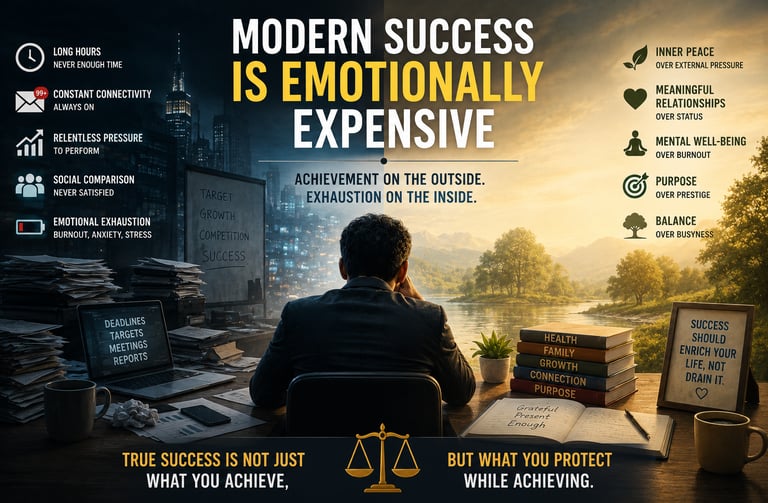
Modern success looks extraordinary from the outside.
A high-paying career.
A growing business.
A polished LinkedIn profile.
Frequent travel.
Luxury lifestyles.
Constant productivity.
Digital influence.
Professional recognition.
In today’s world, achievement has become more visible than ever before.
And yet, behind this culture of visible success, something deeply concerning is quietly unfolding:
millions of people are becoming emotionally exhausted while appearing professionally accomplished.
Across corporate offices, startups, universities, creative industries, and digital platforms, individuals are increasingly struggling with:
burnout,
anxiety,
emotional fatigue,
loneliness,
chronic stress,
and psychological detachment.
Modern success is no longer only financially demanding.
It is emotionally expensive.
We Live in an Era of Permanent Performance
Previous generations experienced clearer boundaries between work and personal life.
Work largely ended after office hours.
Rest was socially accepted.
Privacy still existed.
Comparison remained relatively limited.
Today, those boundaries have collapsed.
Modern professionals now live inside what psychologists increasingly describe as a “performance culture” — an environment where people feel pressure to constantly optimize, improve, produce, and remain visible.
Technology has fundamentally changed human expectations.
People are expected to:
respond instantly,
remain digitally available,
stay productive,
maintain personal brands,
compete continuously,
and adapt rapidly to change.
The nervous system was never designed for nonstop psychological stimulation at this scale.
Yet for many people, hyperconnectivity has become permanent.
Burnout Is Becoming a Global Workplace Crisis
Research increasingly confirms that emotional exhaustion is not an isolated issue.
It is becoming systemic.
The World Health Organization officially recognized burnout as an occupational phenomenon associated with chronic workplace stress that has not been successfully managed. (who.int)
Burnout is characterized by:
emotional exhaustion,
mental distance from work,
cynicism,
reduced effectiveness,
and psychological fatigue.
Recent workplace studies across the United States show rising levels of emotional stress among professionals, especially younger generations navigating economic uncertainty, digital overload, and rising performance expectations.
According to the American Psychological Association’s 2026 stress report, chronic workplace pressure, economic anxiety, and constant connectivity are significantly affecting emotional well-being among working adults. (apa.org)
Gallup research also continues to show that employees experiencing burnout are substantially more likely to:
experience anxiety,
disengage emotionally,
lose motivation,
and suffer declining mental health. (gallup.com)
The modern workplace is producing achievement at extraordinary scale.
But it is also producing emotional fatigue at extraordinary scale.
Social Media Has Changed the Psychology of Success
Success once existed primarily within personal and professional circles.
Today, success is public.
Every day, people are exposed to carefully curated digital representations of achievement:
promotions,
investment wins,
startup exits,
luxury lifestyles,
productivity routines,
fitness transformations,
and entrepreneurial success stories.
Social media transformed success into continuous comparison.
And comparison has psychological consequences.
Research increasingly links excessive social comparison with:
anxiety,
self-esteem issues,
emotional dissatisfaction,
and feelings of inadequacy.
Even highly successful individuals often experience:
imposter syndrome,
fear of irrelevance,
pressure to remain visible,
and anxiety about falling behind.
The emotional burden becomes endless because there is always someone achieving more online.
In the digital age, comparison no longer rests.
High Achievement Often Hides Emotional Isolation
One of the least discussed aspects of modern success is loneliness.
As ambition intensifies, many individuals quietly sacrifice:
time,
relationships,
emotional presence,
and psychological recovery.
Professionals may become surrounded by networks yet emotionally disconnected.
Entrepreneurs may appear independent yet internally overwhelmed.
Executives may lead organizations while privately struggling with exhaustion.
High performers often become trapped inside identities built around productivity.
Over time, many individuals unconsciously begin attaching self-worth to achievement itself.
This creates a dangerous emotional condition:
people begin believing they are valuable only when they are productive.
Rest then begins to feel uncomfortable.
Stillness feels unearned.
And emotional exhaustion becomes normalized.
Economic Pressure Intensified the Emotional Cost of Success
Modern financial realities have amplified psychological pressure significantly.
Today’s professionals face:
rising living costs,
housing affordability crises,
student debt,
job market instability,
AI-related uncertainty,
and increasing competition.
For younger generations especially, success often feels less optional and more necessary for survival.
This creates chronic stress environments where people feel compelled to:
work harder,
remain constantly employable,
build multiple income streams,
maintain digital relevance,
and continuously upgrade themselves.
The result is a culture where many individuals are externally successful but internally depleted.
Hustle Culture Created a Dangerous Illusion
For years, hustle culture promoted the idea that nonstop work represented ambition and discipline.
Phrases like:
“sleep when you’re dead,”
“rise and grind,”
“always hustling,”
and “no days off”
became symbols of modern achievement culture.
But the long-term emotional consequences are now becoming visible.
Mental health experts increasingly warn that chronic overwork contributes to:
anxiety disorders,
sleep disruption,
emotional dysregulation,
depression,
and burnout.
The problem is not ambition itself.
Human progress depends on ambition.
The problem emerges when human beings lose emotional balance while pursuing external success alone.
Technology Accelerated Human Life Beyond Psychological Recovery
Modern technology dramatically increased efficiency.
But it also accelerated psychological pressure.
Today, people consume:
more information,
more news,
more opinions,
more opportunities,
and more social comparison
than any previous generation in history.
The human brain rarely experiences true silence anymore.
Notifications, emails, messages, social feeds, and algorithmic stimulation constantly compete for attention.
As a result, many individuals remain mentally activated even while physically resting.
The nervous system struggles to recover fully.
Over time, chronic overstimulation creates emotional fatigue that achievement alone cannot resolve.
Younger Generations Are Rethinking Success
Millennials and Gen Z are increasingly questioning traditional definitions of success.
Across the United States, younger professionals are openly discussing:
burnout,
work-life balance,
mental health,
emotional sustainability,
and psychological well-being.
The growing popularity of concepts like:
quiet quitting,
soft living,
slow productivity,
and conscious ambition
reflects a broader cultural shift.
Many people are beginning to ask:
What is the emotional cost of constant achievement?
And perhaps more importantly:
Is success meaningful if it destroys inner peace along the way?
Financial Success Does Not Automatically Create Emotional Fulfillment
One of the greatest misconceptions in modern society is the assumption that financial achievement guarantees emotional security.
In reality, external success often introduces:
higher expectations,
increased pressure,
lifestyle inflation,
fear of failure,
and identity dependence on achievement.
Psychological research around “hedonic adaptation” shows that humans rapidly adjust to improved circumstances.
What once felt extraordinary eventually becomes normal.
This explains why many high achievers continue chasing more while still feeling emotionally unsatisfied.
Money can improve comfort and opportunity.
But it cannot fully replace:
emotional stability,
meaningful relationships,
inner clarity,
purpose,
and mental peace.
The Future May Require a More Human Definition of Success
Perhaps modern society is approaching a turning point.
For decades, success was measured primarily through:
income,
status,
productivity,
titles,
and possessions.
But the emotional realities of modern life are forcing many people to reconsider these definitions.
Future success may increasingly include:
emotional resilience,
mental well-being,
meaningful relationships,
depth of focus,
psychological balance,
and the ability to remain internally healthy in a hyperconnected world.
Because achievement without emotional sustainability eventually becomes fragile.
The Most Important Question of Modern Life
Perhaps the defining question of modern success is no longer:
“How successful can I become?”
But rather:
“Can I build a meaningful life without emotionally exhausting myself in the process?”
Because in a world obsessed with performance, protecting emotional well-being may become one of the highest forms of intelligence.
Modern success can create opportunity, influence, and financial freedom.
But if success quietly destroys peace of mind along the way, the victory becomes far more complicated than society often admits.