Why Children Are Becoming Emotionally Exhausted So Early
Many children today are growing up with pressures previous generations never experienced this early. Academic competition. Digital overload. Constant comparison. Fear of failure. Emotional overstimulation. On the outside, many children appear active and connected. But internally, a growing number are becoming emotionally exhausted far too early in life. Childhood was never meant to feel like nonstop performance. Children do not only need success. They need emotional safety, meaningful conversations, rest, play, understanding, and the freedom to grow without constant pressure. Perhaps the real responsibility of adults today is not just preparing children to compete in the world, but helping them remain emotionally healthy within it. Because emotionally secure children often grow into emotionally resilient adults
EDUCATION
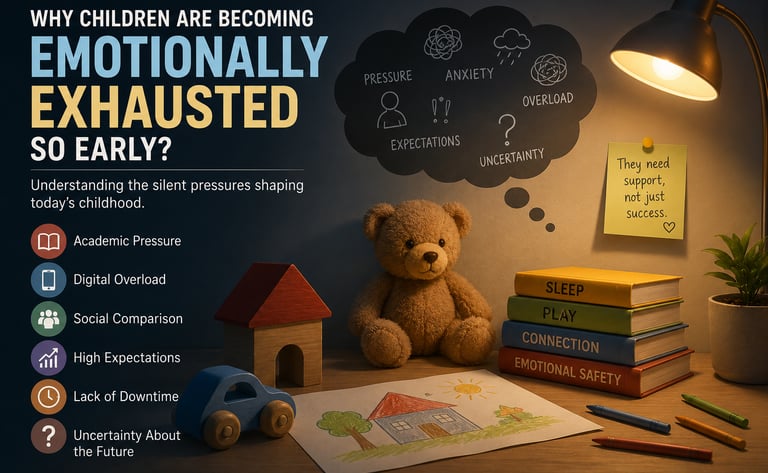
Childhood was once associated with curiosity, imagination, play, and emotional freedom.
Today, many children appear increasingly anxious, mentally overwhelmed, emotionally sensitive, and psychologically tired far earlier than previous generations.
Teachers are noticing it.
Parents are sensing it.
Mental health experts are warning about it.
Across the world, children are growing up in environments filled with constant stimulation, academic pressure, emotional comparison, digital overload, and growing uncertainty about the future.
The result is a generation that often looks connected on the outside but emotionally exhausted within.
And the most concerning part is this:
Many children are experiencing emotional fatigue long before they fully understand what they are feeling.
Childhood Has Become Emotionally Demanding
Modern childhood is no longer emotionally simple.
Children today are navigating pressures that previous generations encountered much later in life.
From an early age, many children are exposed to:
academic competition,
social media comparison,
performance expectations,
overstimulation,
digital dependency,
and fear of falling behind.
At the same time, children are processing global issues constantly visible online:
wars,
climate anxiety,
economic uncertainty,
violence,
and social instability.
The emotional system of a child was never designed to absorb nonstop stimulation and pressure at this scale.
Yet for many young people, emotional overload has become normal.
The Pressure to Perform Starts Earlier Than Ever
In many homes and schools, childhood has quietly become performance-oriented.
Children are encouraged to:
score higher,
compete harder,
learn faster,
achieve earlier,
and constantly stay productive.
While ambition and discipline are important, excessive pressure can create emotional exhaustion when children begin associating self-worth with performance alone.
Many children now grow up fearing:
failure,
rejection,
disappointing parents,
social judgment,
and not being “good enough.”
This creates chronic emotional stress during the most sensitive developmental years of life.
Research Is Raising Serious Concerns
Global reports increasingly show rising emotional and psychological distress among children and adolescents.
The World Health Organization has repeatedly highlighted that mental health conditions among young people are becoming one of the leading causes of illness and disability worldwide. (who.int)
A recent OECD report on youth mental health also found growing concerns around anxiety, emotional distress, sleep problems, and declining psychological well-being among children and adolescents across multiple countries. (oecd.org)
In the United States, conversations around youth mental health have intensified dramatically in schools, parenting communities, and public health discussions.
The emotional exhaustion of children is no longer isolated. It is becoming systemic.
Social Media Changed Childhood Emotionally
One of the biggest transformations in modern childhood is the psychological impact of digital comparison.
Children today are growing up in environments where validation is increasingly externalized through:
likes,
views,
followers,
comments,
and online approval.
Even young children are becoming aware of appearance standards, popularity metrics, and social expectations through digital platforms.
This creates emotional pressure that previous generations rarely experienced at such early ages.
Children are no longer comparing themselves only with classmates.
They are comparing themselves with carefully curated online realities.
The result can include:
insecurity,
anxiety,
fear of exclusion,
emotional dependency on validation,
and declining self-esteem.
Children Are Losing Emotional Recovery Time
One overlooked issue is that children today often have very little emotional downtime.
Schedules are increasingly filled with:
school,
coaching,
activities,
screen time,
digital entertainment,
and constant engagement.
But emotional development requires moments of:
silence,
boredom,
reflection,
play,
imagination,
and rest.
Without these spaces, the nervous system remains continuously stimulated.
Over time, constant stimulation can lead to emotional fatigue.
A child may appear physically active while internally feeling mentally drained.
Parents Are Also Emotionally Overwhelmed
Modern parenting itself has become emotionally demanding.
Many parents today are balancing:
financial pressure,
work stress,
digital overload,
and fears about the future.
As a result, emotional stress within adults can unintentionally transfer into the emotional environments children grow up in.
Children are deeply sensitive to:
emotional tension,
parental anxiety,
conflict,
overstimulation,
and emotional unavailability.
Even when parents are doing their best, emotionally exhausted households can unintentionally create emotionally exhausted children.
Emotional Intelligence Is Becoming More Important Than Ever
In a rapidly changing world, emotional resilience may become one of the most important life skills children develop.
Children need more than academic preparation.
They need:
emotional security,
healthy communication,
self-awareness,
empathy,
coping skills,
and psychological balance.
The future will not only test intelligence. It will test emotional strength.
Children who learn how to:
manage stress,
process emotions,
handle failure,
build meaningful relationships,
and remain mentally grounded
may be far better prepared for life than children raised only to achieve externally.
Technology Is Not the Enemy — Imbalance Is
Technology itself is not inherently harmful.
Digital tools can educate, inspire, and connect children in extraordinary ways.
The problem emerges when technology replaces:
human connection,
outdoor play,
sleep,
reflection,
creativity,
and emotional presence.
Children need balance.
They need environments where they can experience both:
digital learning,
and emotional stillness.
Without balance, constant stimulation can quietly overwhelm the emotional system.
What Children Need Most Today
Children do not only need success. They need safety.
They need:
emotionally available adults,
meaningful conversations,
time without pressure,
genuine attention,
encouragement without comparison,
and the freedom to grow without constant judgment.
Sometimes the greatest gift adults can give children is not more achievement pressure, but emotional calmness.
Children thrive not merely when they are pushed to perform, but when they feel emotionally secure enough to become themselves.
The Question Society Must Ask
Modern society has become highly focused on preparing children for competition.
But perhaps we also need to ask:
Are we preparing children emotionally for life itself?
Because a generation that grows up emotionally exhausted may struggle not only academically or professionally, but psychologically.
And if childhood becomes dominated by pressure, comparison, overstimulation, and emotional fatigue, we risk raising children who know how to perform but do not know how to feel emotionally healthy within themselves.
The future of education may therefore require more than academic excellence.
It may require protecting the emotional well-being of childhood itself.